The Agentic AI War: How OpenAI, Anthropic, Grok, Meta, Google and Microsoft Are Building Digital Workers
Agentic AI is moving artificial intelligence beyond the chatbot. A new generation of AI agents—including Grok Bot, OpenAI Dots, Claude Duet, Meta Muse, Google Gemini Spark and Microsoft Scout and Autopilot—is designed to remember context, monitor connected applications and complete multi-step work through cloud computers. These always-on AI agents are competing to become digital workers: the trusted execution layer between people, organizational knowledge and business systems.
For the past several years, the dominant interface for artificial intelligence has been a blank chat window. A person asks; the AI assistant answers. Even when the answer is excellent, the human usually remains responsible for carrying it into the real world.
That model is now changing.
In less than three months, Grok launched Grok Bot, OpenAI introduced Dots, Meta released Muse, and Anthropic opened a preview of Claude Duet. Each has its own personality and target audience, but their shared ambition is unmistakable: to move AI from a tool that waits for instructions to an agent that maintains context, notices what needs attention, and completes work across applications—often while the user is elsewhere.
The chatbot competition is becoming an agentic AI platform war.
The prize is not simply the title of "smartest model." It is the right to become the persistent intelligence and execution layer between people and the systems through which they work.
Key takeaways
- AI assistants are becoming AI agents. The operating model is shifting from answering prompts to executing continuing, multi-step workflows.
- The emerging category is the digital worker. Persistent memory, connected tools, cloud computing and proactive monitoring allow agentic systems to keep working after a chat ends.
- Enterprise AI adoption will depend on governance. Permissions, human-in-the-loop approval, identity, audit logs, cybersecurity and reliable sources of truth matter as much as model intelligence.
- Institutional context may become the durable advantage. An organization's governed memory and workflow—not an isolated prompt—will determine whether AI automation is dependable.
1Agentic AI launches accelerated in 2026
The recent launch sequence makes the acceleration visible.
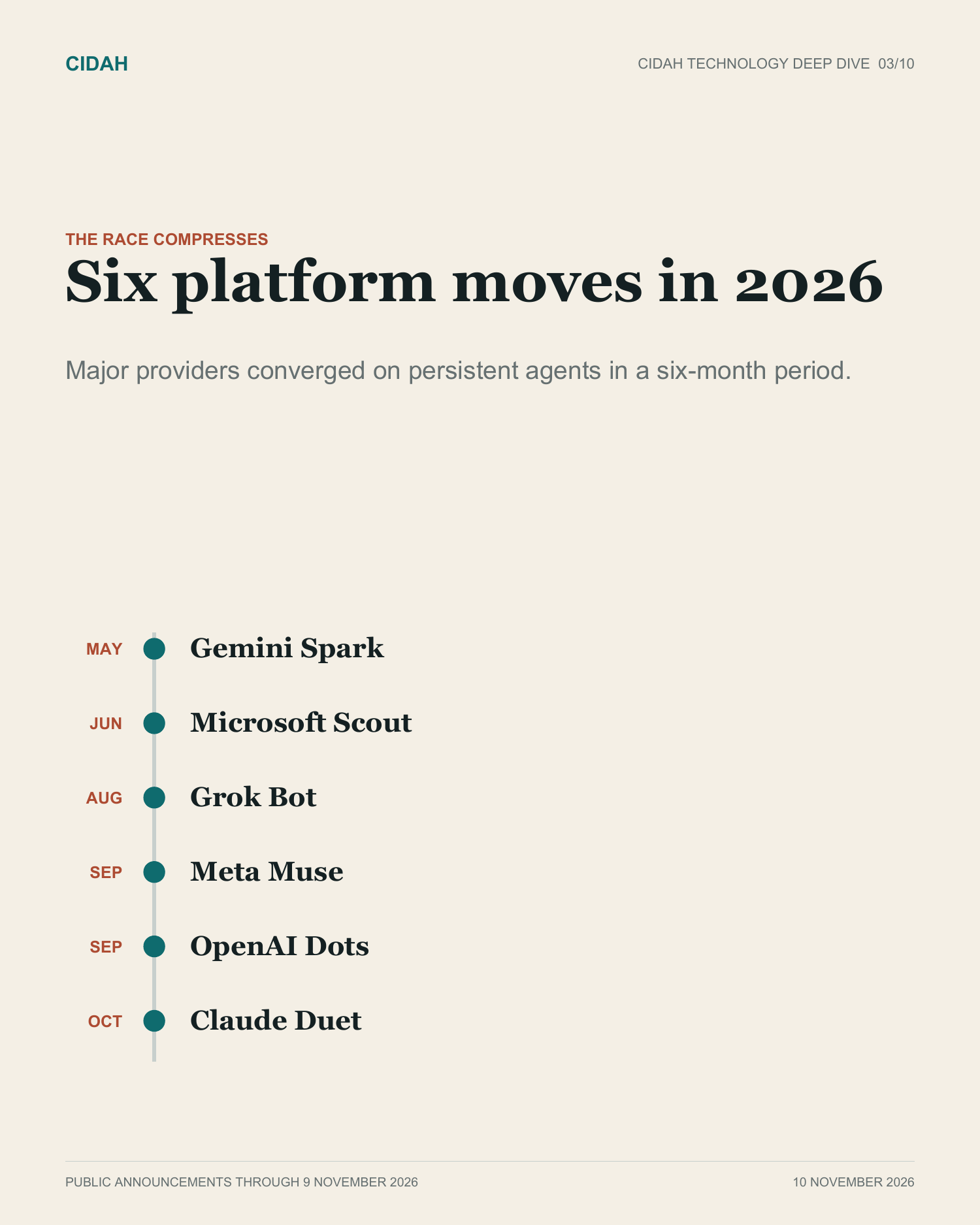
On 11 August, Grok Bot arrived as a team of always-on AI coworkers. Its Bots have a cloud computer, remember how work is performed and can coordinate with one another. A "chief of staff" Bot can manage specialists responsible for inboxes, expenses, recruiting, operations or software development.
On 8 September, Meta introduced Muse, a consumer-oriented agent with its own secure virtual machine and direct access to Meta's formidable distribution channels. It can work across connected services, pursue longer-term goals and seek approval before sensitive actions.
On 29 September, OpenAI introduced Dots. A dot has its own cloud computer, connects to applications through OpenAI's plugin ecosystem, maintains ongoing context and performs "proactive research" between conversations. OpenAI is also piloting specialist organizational dots with dedicated responsibilities, identities and credentials.
On 21 October, Anthropic introduced Claude Duet, a proactive agent aimed initially at professionals and small-business owners. Duet sends a morning brief, checks connected applications periodically, undertakes longer assignments and waits for approval when a consequential action requires the user's judgment.
These were not the first moves. Google announced Gemini Spark in May as a 24/7 personal agent integrated with Google Workspace. In June, Microsoft introduced Scout—subsequently incorporated into its Autopilot direction—as an always-on organizational agent grounded in Microsoft 365 and governed through enterprise identity and data controls.
The significant fact is therefore not that one company invented the category. It is that nearly every major AI platform has converged on it.
2What is agentic AI—and how is an AI agent different from a chatbot?
Traditional chat systems are session-based. The user initiates the exchange, supplies context, reviews the response and decides what to do next.
Agentic AI systems are designed around a different operating model:
- They persist beyond one conversation.
- They remember preferences, corrections and continuing responsibilities.
- They have access to a cloud computer, browser or both.
- They connect to email, calendars, files, messaging systems and business applications.
- They can be activated by a schedule, an event or a change in connected information—not only by a new prompt.
- They return to the user when work is complete or when a decision requires human judgment.
This is more than an incremental feature upgrade. It changes the basic human-machine relationship from operating an AI assistant to delegating responsibility to an AI agent.
That distinction is why the providers increasingly use the language of teammates, coworkers, companions and chiefs of staff. The interface is no longer organised solely around a list of disposable chats. It is beginning to resemble a roster of persistent actors, each with a role, context, tools and continuing work.
3How cloud computers turn AI assistants into autonomous agents
The cloud computer is the quiet architectural breakthrough behind this category.
An ordinary AI assistant can propose an email, describe how to update a spreadsheet or provide instructions for navigating a website. An AI agent with a cloud computer can open the application, create the draft, update the file, inspect the result and continue to the next step. Its work does not need to stop when the user's laptop closes. This bounded autonomy is what makes agentic workflows materially different from conversational AI.
This also allows agents to operate services that lack a clean API. If a person can complete a task through a browser, an agent may be able to do the same. That vastly expands the addressable surface of digital work.
But browser access is also a source of fragility and risk. Web interfaces change. Pages contain untrusted content. An email, document or website can include malicious instructions intended to redirect an agent. The same persistence that makes an agent useful can allow a bad instruction or false fact to influence later work if it enters long-term memory.
The cloud computer therefore creates both the execution layer and the security problem the providers must solve.
4Six battlegrounds in the agentic AI platform race
4.1 Distribution: where enterprise AI agents will live
Model quality matters, but distribution determines which agent users can adopt without changing how they already work.
Microsoft begins inside Outlook, Teams, OneDrive, SharePoint, Entra and Purview. Google begins with Gmail, Calendar, Workspace and Android. Meta can place Muse beside billions of users in WhatsApp and its social ecosystem. OpenAI brings the ChatGPT and Codex user bases, plugins and workplace channels. Grok connects X, Grok, Cursor and a particularly agent-oriented technical community. Anthropic brings Claude, Claude Code and a reputation among professional users for careful model behaviour.
The likely winner may not be the agent with the highest benchmark score. It may be the one that is already present where the user's work, relationships and data live.
4.2 Persistent memory and organizational context
An always-on agent becomes valuable when it no longer needs the user to explain the same background repeatedly. It must know what matters, which sources are authoritative, what "good" looks like and when a deviation deserves attention.
That context can become a durable competitive moat. Once an agent has learned a person's preferences, accumulated project history, connected applications and absorbed corrections, changing providers is no longer equivalent to changing a search engine. The user may need to reconstruct a working relationship.
Portability of memory, skills, routines and permissions may consequently become as important as portability of documents.
4.3 AI automation and dependable execution
The difference between a useful demonstration and a dependable worker lies in the final mile.
Can the agent merely recommend a change, or can it make the change in the correct system? Can it complete a multi-step assignment across several applications? Can it recover when a page fails, information is missing or two sources conflict? Can it identify the point at which progress requires human judgment?
The real benchmark is not how persuasively an agent describes completed work. It is whether the work has actually landed in the right place, in the right form, with evidence that it was done correctly.
4.4 AI governance, cybersecurity and human oversight
The major providers are all treating permissions and approvals as core product features.
OpenAI describes custom rules, activity monitoring and an automated reviewer for sensitive actions. Anthropic has detailed a separate action classifier, credential isolation and checks intended to prevent sensitive information from leaving through an outgoing message. Grok Bot documents independent action review, network policies and approval gates. Meta says Muse uses a separate Sentinel agent to review outbound activity. Microsoft emphasizes governed agent identities, scoped credentials and the application of existing Purview policies.
These are meaningful design choices. They are not proof that the problem has been solved.
Approval prompts can become routine. Users may approve an action they do not fully understand. Malicious instructions can arrive through apparently ordinary emails, files or web pages. Persistent memory creates the possibility of "memory poisoning", where compromised information affects future decisions long after the original content was encountered. Multi-agent systems may spread defective context or instructions from one agent to another.
Trust will therefore depend on a layered system: limited access, clear responsibility, visible proposed actions, independent checks, reliable logs, revocation mechanisms and human review proportionate to consequence.
4.5 Agent identity, access control and auditability
When an agent acts, who is acting?
Some products operate principally through the user's existing authority. Others are moving toward dedicated agent identities and credentials. The distinction affects attribution, permissions, auditing, revocation and the ability to separate one role from another.
Microsoft's emphasis on governed Entra identities and OpenAI's specialist organizational dots point toward a future in which agents are first-class participants in enterprise identity systems. Organizations may eventually maintain directories containing both people and digital workers, each with a defined role and bounded authority.
4.6 Multi-agent systems and the digital workforce
The ultimate product may not be one universal personal assistant.
Grok Bot already presents the user with multiple specialists that can work in parallel and coordinate through a chief-of-staff Bot. OpenAI is developing specialist dots for organizational responsibilities. Google has announced custom sub-agents. This suggests a move from an individual assistant toward a managed digital workforce.
That shift changes the management problem. Organizations will need to know which agents exist, what each one knows, which tools each may use, how they communicate, which agent is accountable for a task and when a person must intervene.
5Why governed institutional knowledge becomes the AI advantage
The agentic transition is often presented as a story about autonomy. For professional organizations, it is equally a story about context.
An agent cannot act reliably if it cannot distinguish an authoritative document from a discarded draft; a current instruction from an outdated one; one client, project or matter from another; or a general preference from a binding rule.
The quality of the agent's environment will therefore matter as much as the quality of its model. That environment includes:
- reliable sources of truth;
- clear project and matter boundaries;
- provenance and version history;
- role-based access;
- explicit approval thresholds;
- retained institutional knowledge; and
- an auditable record of actions and corrections.
This is particularly important in high-trust professional work. More capable agents increase the cost of disorganized knowledge because they can act on ambiguity at machine speed.
From CIDAH's perspective, the key lesson is straightforward: the prompt is not the institutional asset. The governed memory and workflow surrounding it are.
6What agentic AI means for law firms and professional services
Law firms, accounting firms, consultancies and other professional-services organizations are natural candidates for AI agents because much of their work crosses email, documents, calendars, knowledge systems and client or matter records. A bounded agentic workflow could monitor a defined source, prepare a comparison, update a working draft or alert a professional when a decision is required.
The same environments also expose the limits of generic autonomous AI. Confidentiality, legal privilege, conflicts, client and matter separation, professional responsibility and the need to reconstruct important decisions make context boundaries essential. An enterprise AI agent must know not only what information is available, but which client, matter, project or role may use it—and which proposed actions require a lawyer or other accountable professional.
For high-trust organizations, responsible AI adoption therefore means more than selecting an AI model. It requires an agent-governance architecture: authoritative sources, least-privilege access, human-in-the-loop approvals, provenance, audit logs, escalation rules and the ability to revoke permissions or retained context.
7Enterprise AI readiness: what organizations should do now
The current products remain early. Several are in beta, research preview, private preview or gradual rollout, and availability differs by geography and plan. Organizations do not need to choose a permanent winner today.
They should, however, prepare for the operating model these products represent.
- Start with bounded work. Select tasks with clear inputs, verifiable outputs and limited downside.
- Separate reading from acting. Begin with research, monitoring and drafts before permitting external communication or system changes.
- Use least privilege. Give an agent only the sources and tools required for its defined role.
- Define stopping points. State which actions always require human review and what evidence the reviewer must see.
- Protect the sources of truth. Clean, current and well-structured context is a prerequisite for reliable delegation.
- Keep an action record. Important work should be attributable and reconstructable.
- Plan for portability. Understand how memories, routines, data and permissions can be exported, reset or deleted before they become operational dependencies.
- Measure completed work, not fluent output. Evaluate correctness, recovery, escalation and the quality of the final artifact—not merely the conversation.
8Frequently asked questions about agentic AI and AI agents
- What is agentic AI?
- Agentic AI describes artificial-intelligence systems that can pursue a goal across multiple steps, use tools, retain relevant context and continue work with limited supervision. Unlike a conventional chatbot, an AI agent may monitor events, operate applications and return when it has completed work or needs human judgment.
- What is the difference between an AI assistant and an AI agent?
- An AI assistant generally responds within a user-initiated conversation. An AI agent can maintain continuing responsibilities, connect to external systems and execute an agentic workflow over time. In practice, autonomy exists on a spectrum: responsible systems should impose permissions, approval points and human oversight according to the consequence of the action.
- Which companies are building always-on AI agents?
- The emerging market includes Grok Bot, OpenAI Dots, Anthropic's Claude Duet, Meta Muse, Google Gemini Spark and Microsoft Scout and Autopilot. Their designs differ, but each points toward persistent AI coworkers or digital workers with memory, connected tools and the ability to continue tasks beyond one chat session.
- What are the main risks of autonomous AI agents?
- The principal risks include excessive permissions, prompt injection, malicious or untrusted content, memory poisoning, disclosure of sensitive information, mistaken external actions, weak identity controls and poor auditability. Approval prompts alone are insufficient; organizations need layered AI governance and reliable recovery mechanisms.
- How should an organization prepare for enterprise AI agents?
- Begin with bounded, verifiable work. Separate reading and drafting from external action, apply least-privilege access, define mandatory human approval points, protect authoritative knowledge sources, retain action records and test how permissions and memory can be revoked or reset.
- Who is winning the agentic AI war?
- It is too early to declare a winner in the agentic war. Grok Bot currently makes the multi-agent workforce metaphor unusually concrete. OpenAI can combine a vast consumer base with Codex, plugins and organizational agents. Anthropic is differentiating around professional judgment and discretion. Meta has unmatched consumer distribution. Google and Microsoft control much of the productivity infrastructure in which work already occurs. The more important conclusion is that the direction of travel is now clear.
AI is moving out of the chat window. It is acquiring memory, tools, computers, identities and continuing responsibilities. The next platform will not merely answer questions. It will decide what requires attention, carry work across systems and return when human judgment is needed.
The agentic war has begun. The ultimate contest is over who—or what—we trust to act.
Editorial note. This article reflects publicly available information as of 9 November 2026. Several products discussed are in beta, preview or staged rollout. Descriptions of safeguards and capabilities are based substantially on provider documentation and should be understood as product claims unless independently validated.
How this publication was made. This publication was produced with the assistance of AI and agentic tools for research, analysis, drafting and independent editorial challenge. Human editors directed the work and reviewed the supporting sources; the text will be subject to human approval before publication. We disclose this because the method is relevant to the subject—and because responsible AI adoption should be transparent.